


Because dreams are more about sensation than narrative, Dominique Dupray creates images where logic dissolves in favor of atmosphere. The deliberate absence of explicit concepts is not a void: it constitutes the very framework of the experience. Each composition, sometimes abstract, sometimes expressionistic, rejects narration and remains detached from any imposed symbolism.
Here, priority is given to plastic tension. Masses, contrasts, and lines of force structure the space before any interpretation. The image does not explain; it acts.
The specificity of these works lies in the fusion of preliminary work for painting, photography, and digital processing. Between capture and transformation, the photograph is reworked until it loses its descriptive function. The "Lands" are thus constructed from reality but detached from it.
The whole composes a hybrid territory where the visible becomes blurred and where perception takes precedence over meaning.
Dreamlike fragrances
A series dedicated to imaginary worlds, Land of Dreams Land of Darkness depicts states of space rather than landscapes.
These territories are neither science fiction nor illustrative fantasy. They stem from an inner vision. Each image offers a mental geography where the gaze wanders without fixed points of reference.
The landscape becomes a projection. It doesn't suggest a place, but rather a drift.


Land of Dreams Land of Darkness
At the Social Theater

Déambulation entre des portraits anthropomorphes dont la canne qu'ils tiennent dépassent des cadres. Oeuvres majoritairement noire et blanche. Seuls les cadres marrons font touches de couleurs

Dans une oeuvre majoritairement rouge et marrons où les mouvements de peinture sont soulignés de blancs, sont incorporés en arrière plan, sur un mur bordeau, des oeuvres de l'artiste Dominique Dupray. L'une d'entre elle semble s'être décrochée et déambule au grès du mouvement de la peinture au sol

Sur fond sombre un visage apparait dans un rectangle blanc. Quelques touches de rouge éclairentl'ensemble
Déambulation entre des portraits anthropomorphes dont la canne qu'ils tiennent dépassent des cadres. Oeuvres majoritairement noire et blanche. Seuls les cadres marrons font touches de couleurs
In "At Social Theater", Dominique Dupray observes ordinary gestures: scenes of work, moments of leisure, collective situations.
The term “theater” does not refer to fiction but to the interplay of roles. Each individual appears as an actor within a social framework whose rules are implicit. Postures, distances, and glances become meaningful.
The pictorial transformation alters the documentary reading. Reality is shifted toward a more symbolic dimension, without becoming narrative. What is revealed are the invisible structures of everyday life.
Inner Look

Visage au milieu d'un assemblage griffé de peinture grise

Anthropoformes dans un paysage urbain irréel et futuriste

Sur fond bleu nuit, un ruban doré semble formé un coeur
Visage au milieu d'un assemblage griffé de peinture grise
Inner Look offers a mental journey. Space takes the form of successive chambers: consciousness, memory, regret... Thresholds are crossed, doors traversed.
This is not an autobiographical narrative, but a psychic architecture. Each room corresponds to a state, a particular density.
The light is more subdued, sometimes diffuse. Outlines are blurred. The image functions as an intimate space for projection, where the viewer is invited to move freely.
The Chamber of Life's Trials
 |  |
|---|---|
 |  |
 |  |
 |  |
 |  |
 |  |
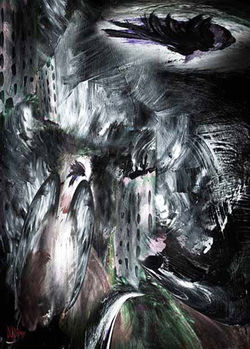
This series explores mental and physical tensions without seeking literal illustration. Bodies are fragmented, sometimes deformed, sometimes dissolved into matter.
Pain is not staged; it is suggested through formal imbalances, spatial compressions, and abrupt contrasts. The image becomes a surface of friction.
The aim is not to represent suffering, but to convey its pressure.
 |  |  |
|---|---|---|
 |  |  |
 |  |  |
 |  |  |
 |  |  |
 |  |  |
 |  |  |
 |  |
Creatures
Real or imagined, the figures in Creatures oscillate between recognition and strangeness. Some seem to have sprung from the living, others from a formal drift.
The pictorial treatment accentuates this ambiguity: organic textures, uncertain outlines, hybrid forms.
These presences do not belong to the narrative bestiary. They embody forces, pulsations, forms in flux.
Panorama
 |  |  |
|---|---|---|
 |  |  |
 |  |  |
In Panorama, the expanded format transforms perception. The selected landscapes are not the most descriptive but the most structuring.
The gaze is forced to move laterally. Space stretches, time elongates.
The panoramic dimension does not aim for monumentality but for immersion. The landscape becomes a field of experience rather than mere scenery.
