


Fragrances of situations
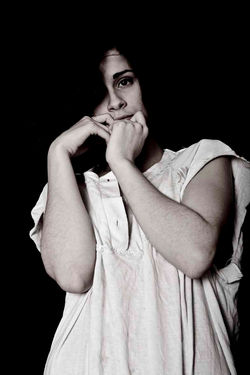
Rather than adopting the expected documentary approach (capturing in black and white an already overexposed misery), Dominique Dupray chose to offer a reconstruction. Not to soften the violence, but to question its visual construction.
In a Parisian cellar with deliberately harsh lighting, young women, dressed in simple torn nightgowns, take their places in a dirty setting. The poses are conceived in accordance with the atmosphere: restrained, constrained, sometimes frontal. The space is cramped, the air seems sticky.
The technical choices are part of the approach. An entry-level SLR camera, an ordinary lens. A rejection of virtuosity, a rejection of the overly controlled image. The photographic material retains a certain roughness.
From this session emerged the series Capture, published as a book available on this website. This page presents a selection from the fifty plates that make up the collection.
The following projects extend this exploration of portraiture. Always the face, always presence. But displaced, transformed, questioned through distinct approaches.
Dominique Dupray
Multidisciplinary Artist
Parenthesis
Parentheses combines aphorisms and images. Each brief phrase finds its echo in a photograph or photographic painting.
The text does not illustrate the image, nor does the image comment on the text. The two elements coexist in a relationship of tension. The photograph opens a space for interpretation; the aphorism shifts it.
It is less about explaining than about creating a suspension—a pause for thought.


 |  |
|---|---|
 |  |
 |  |
 |  |
 |  |
 |  |
 |  |
 |  |
 |  |
When light shapes...
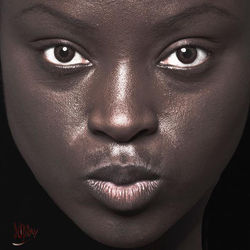
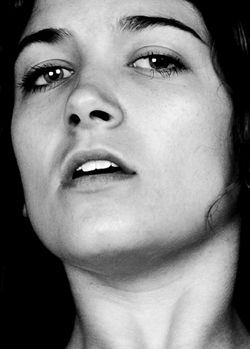
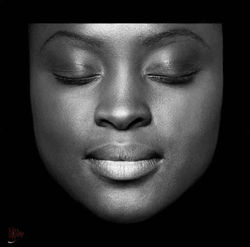
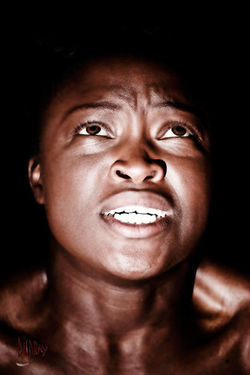
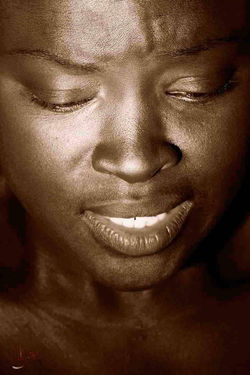
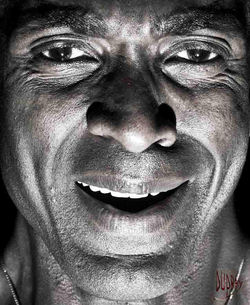
This series brings together portraits of men and women captured with a deliberate economy of means. Black and white dominates, reducing the image to its essentials: light, texture, gaze.
The expressions are not directed toward a single narrative. Fear, sadness, serenity, arrogance—these states coexist without hierarchy. Some gazes confront the lens, others turn away. The camera is not always a mirror, sometimes merely a witness.
Dominique Dupray does not seek the model's social identity but rather the inner tension that surfaces on the face. The portrait becomes a space for projection: what we believe we see belongs as much to the viewer as to the subject.
Presence

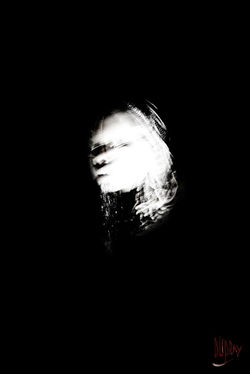
Black and white photograph of a blurred, overexposed face, giving the effect of a double face. On a black background. Image by Dominique Dupray
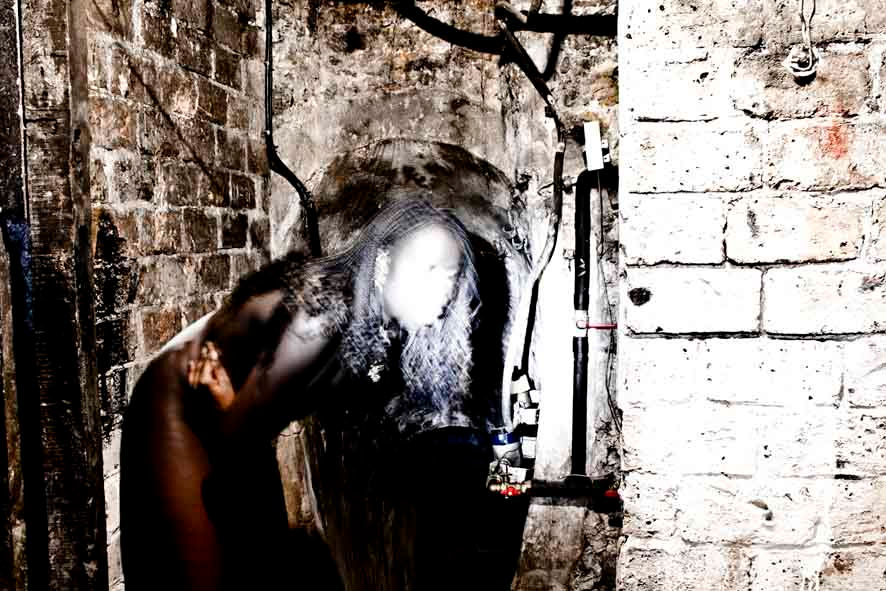
Photograph taken in a basement with a tunnel in the background, exposed brickwork. A dark-skinned woman is bent forward with her mouth open. Textured work adorns the woman's body.

Black and white photograph of a woman's face whose hair blends into the black background. Her arm emerges to touch a brick wall on the right, from which another face appears. Dominique Dupray
Black and white photograph of a blurred, overexposed face, giving the effect of a double face. On a black background. Image by Dominique Dupray
The series "Presence" explores the female figure in a dark, almost subterranean space. The bodies appear in dense twilight, as if extracted from an enclosed space (cellar, basement, etc.). Nothing is decorative. The environment is reduced to a black, absorbing substance.
The blur is not an effect but a principle of construction. It introduces movement into the image, weakening the contours by destabilizing photographic stillness. The subject is never completely still: it traverses the space, disturbing it in order to inhabit it.
In this black and white work, light acts as a minimal developer. It sculpts the volumes that brush against the skin. A trajectory is captured rather than a posture. Thus, the figure becomes a passage, like a vibration.
"Presence" questions what remains when identity dissolves in movement. It is not the portrait of an individual, but the affirmation of an existence in darkness. A fragile and unstable, yet irreducible, presence.
The Soul in Plastic
In this series, Dominique Dupray explores the boundary between the living and the artificial. The figures—mannequins, frozen bodies, manufactured presences—seem imbued with a silent tension. Plastic becomes skin, envelope, mask, and metaphor.
The light, often sharp, sculpts the volumes like a sonic material. The bodies appear simultaneously sensual and distant, offered and inaccessible. A petal suspended in the air, a frozen gesture, a blank stare: all these are clues to a humanity displaced toward the object.
Between industrial coldness and latent sensuality, *The Plastic Soul* explores a contemporary condition where identity is manufactured, molded, and displayed. The image becomes a space of friction: geometry against flesh, surface against interiority, synthetic material against the yearning for the soul.
A contemporary musician as well as a geometric figurative painter, Dominique Dupray here transposes his visual language into a photographic mise-en-scène where rhythm, contrast, and formal tension compose a visual score.
 |
|---|
 |
 |
 |
 |
 |
 |


